

Call our head office number today to book a survey 023 9243 0183, or book online
The History of Wall Ties in the UK
Cavity walls incorporating metal wall ties have been integral to British construction since the early 19th century. The first recorded use of cavity wall construction was in 1820s Liverpool, where builders began experimenting with dual-skin walls to reduce damp penetration in the city’s often wet climate. These early cavity walls were a major departure from traditional solid brick construction and laid the foundation for widespread adoption decades later.
It wasn’t until the building boom of the 1880s, spurred on by industrialisation and urban housing demand, that cavity wall dwellings became commonplace. The technique offered a solution to damp problems and significantly improved insulation performance—an early example of what we might now call “building science.” By 1945, cavity wall construction had become the norm for residential and many public buildings, prized for its structural strength and its ability to resist moisture in the UK’s challenging weather conditions.
Early Materials and the Issue of Longevity
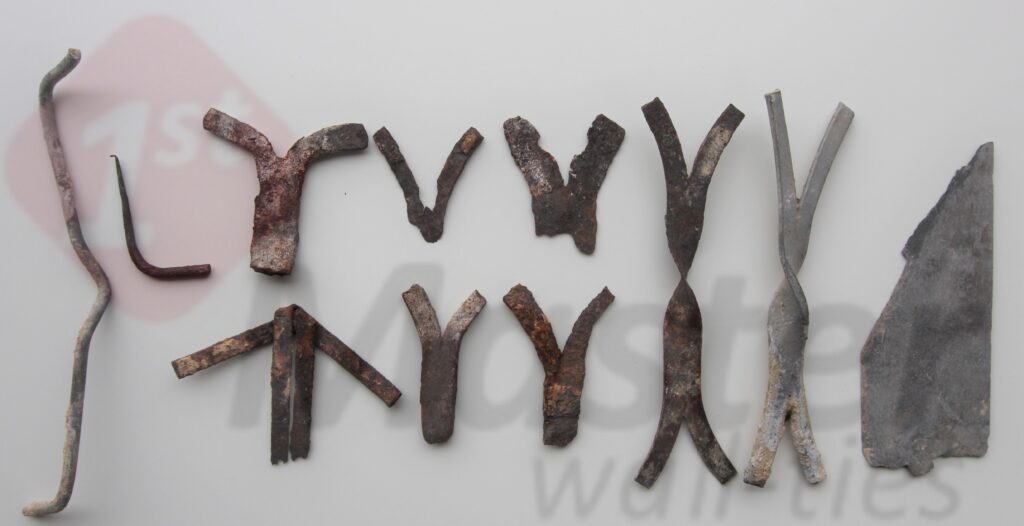
In the early days, wall ties were crafted from wrought or cast iron—materials readily available thanks to the booming iron industry. Cast iron was durable but brittle, while wrought iron was more flexible but prone to long-term rusting. Over time, these were replaced by mild steel ties, which were either galvanized with zinc or coated in bitumen. These coatings were intended to provide corrosion resistance, and under ideal conditions, ties had an expected lifespan of around 60 years.
However, that lifespan proved optimistic. Builders and engineers soon discovered that even galvanised ties could corrode much earlier, especially in the presence of aggressive mortars, marine air, or poor workmanship. In fact, many of the ties installed in the 1950s and 60s began failing by the late 1970s—far ahead of expectations.
One lesser-known fact is that some manufacturers in the post-war era used substandard galvanizing methods due to material shortages, especially during the post-WWII reconstruction period. This left many homes with ties that were inadequately protected from the outset.
1981: A Turning Point
Recognising the scale of the problem, the British Standards Institution (BSI) revised the standard for wall ties in 1981, tripling the zinc coating thickness on wire ties from 20 microns to 60 microns. This major change helped slow corrosion, but it also signified just how widespread and costly the issue had become. Some estimates suggest that up to 10 million UK homes could be affected by cavity wall distress.
Interestingly, in some coastal regions like Cornwall and Kent, failure rates were so high that local councils commissioned large-scale survey programmes and pioneered early wall tie replacement techniques that are still in use today.
Common Causes of Wall Tie Failure
Wall tie corrosion is often accelerated by a combination of environmental and material-related factors. Some of the most significant include:
-
Inferior bitumen coatings, which became brittle over time and lost adhesion
-
Thin or inconsistent zinc galvanizing, particularly in early mass-produced ties
-
Black ash mortar, which contains sulphur and speeds up corrosion
-
Coastal exposure, especially where salt-laden air reaches cavity spaces
-
Porous or soft mortar, which allows moisture ingress and rapid carbonation
A little-known technical detail: carbonation, a chemical reaction between mortar and atmospheric CO₂, reduces the alkalinity of mortar and makes it less protective of embedded metals—greatly increasing corrosion risk.
Tie Types and Their Failures
Several tie types have been used historically, each with their own quirks:
-
Cast and wrought iron ties are prone to expansion as they rust, causing outward pressure that leads to horizontal or stepped cracks in the outer brickwork. The cracking often aligns with the course of the ties, making it a telltale diagnostic sign.
-
Stone or slate ties—sometimes used in older buildings—can snap with building movement, though they usually don’t cause extensive cracking.
-
Brick and mortar ties were often a product of necessity or experimentation and tend to perish without dramatically affecting the wall’s structure.
Butterfly ties, a later development from the mid-20th century, were designed for speed and flexibility in construction. These can sometimes be left in place during remedial work, but their suitability depends on factors like wall thickness and joint condition.
Inspection and Modern Repair Techniques
Many modern surveyors use metal detectors, borescopes, and wall tie locators to find and assess ties within the cavity. Advanced inspections may also include endoscopic cameras and corrosion sensors, especially in high-value or heritage properties.
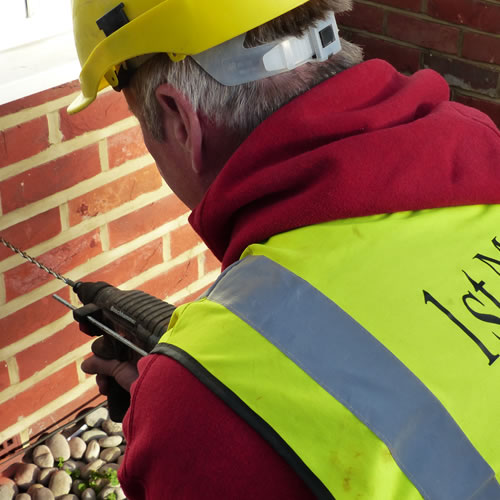
When replacement is necessary, stainless steel remedial ties are typically used today due to their exceptional corrosion resistance and long lifespan. Modern installation often involves isolating the old ties (to prevent further cracking) and inserting new ones through pre-drilled holes—minimally invasive and structurally sound.
Serving the South Coast and Beyond
We proudly offer wall tie surveys and remedial services across the South of England, including:
Hampshire, Dorset, West Sussex, London, Portsmouth, Southampton, Bournemouth, Poole, Dorchester, Chichester, Brighton, Worthing, and Hove.
Our experienced team can identify early signs of cavity wall distress and provide cost-effective solutions to protect your property’s structure.